
Reliable urban water distribution systems depend increasingly on real-time monitoring and intelligent control. This case study demonstrates how the integration of SCADA and Automation significantly improved pressure stability, accelerated operational response, and enhanced overall service quality in a modern water distribution network.
Manual Operations and Limited System Visibility
Before modernization, the distribution network faced several operational challenges:
- Highly fluctuating water pressure due to manual pump operation
- Pressure Reducing Valves (PRVs) functioning without automated control
- Leakage detection was slow due to lack of real-time pressure and flow data
- Operators were required to visit field locations frequently
- No centralized control room to coordinate all distribution zones
- Troubleshooting took considerable time due to fragmented data
These limitations contributed to customer complaints, energy inefficiency, water loss, and slow response to network issues.
Network-Wide Integration of SCADA and Automation
WSI designed and deployed a fully integrated solution combining SCADA with automated controls across pumping stations, reservoirs, PRVs/valves, and District Metering Areas (DMAs).
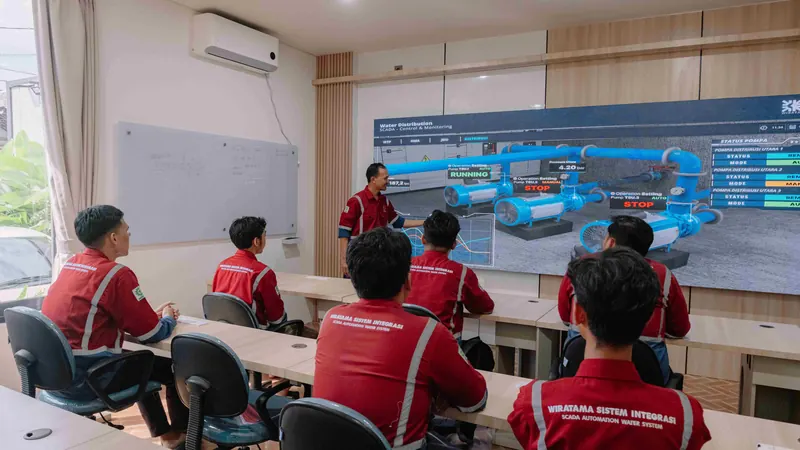
1. Centralized SCADA Platform
The SCADA system provides:
- Real-time monitoring of pressure, flow, and reservoir levels
- GIS-based distribution network visualization
- Alarm notifications for abnormal operating conditions
- Historical trends for pressure, flow, and energy usage
- Automated daily and monthly reporting
Operators now have full visibility of the entire network from one dashboard.
2. Pumping Station Automation
Pump control automation includes:
- PLC-based automatic pressure regulation
- Operation scheduling aligned with customer demand patterns
- Efficient day/night mode operation
- Automatic pump speed adjustment to maintain network stability
This eliminates inconsistent manual pump operation and improves system reliability.
3. Automated PRV and Valve Control
Valves now adjust dynamically based on:
- Inlet and outlet pressure
- Nearby reservoir levels
- Real-time consumption patterns
When pressure rises too high, valves automatically modulate to protect pipelines and reduce leakage potential.
4. Comprehensive DMA Monitoring
Each DMA is equipped with:
- Digital flowmeters
- Pressure transmitters
- Night-flow based leakage detection alarms
- Real-time comparison between hydraulic model and live data
This enables rapid detection of anomalies without manual field inspection.
Significant Improvements in Water Distribution Performance
Key Area | Before Integration | After SCADA & Automation
Pressure Stability | Unreliable | More stable and controlled
Leakage Detection | Manual | Automated, faster detection
Response Time | Slow | Much quicker and more accurate
Pump Operation | Inefficient | Automated and optimized
Customer Service | Frequent complaints | Noticeable improvement
Network Monitoring | Fragmented | Centralized and real-time
The network now operates with greater stability, efficiency, and transparency.
Additional Benefits
The integration of SCADA and automation provides:
- Earlier identification of water loss and leakage
- Reduced pipeline stress due to controlled pressure
- Extended lifespan of pumps and valves
- Reduced need for field inspections
- Improved operator productivity through data-driven decision-making
- A foundation for future smart water utility development
This transformation strengthens operational reliability at every level.
WSI’s Expertise in SCADA & Automation
WSI has implemented SCADA and automation systems in numerous facilities, including:
- WTP Kalidendeng
- WTP Kedung Putri
- PAM Jaya (distribution SCADA and pressure management)
- WTJJ
- BBWS automated floodgate systems
- I Gusti Ngurah Rai Airport utility SCADA
- Water supply automation for Adaro
These projects highlight WSI’s capability in delivering reliable, end-to-end integrated systems.
A Blueprint for Smart Water Distribution
Modern water distribution requires:
- Centralized SCADA
- Automated pump and valve control
- DMA monitoring
- Pressure and flow analytics
- Predictive and automated decision-making
SCADA and automation integration is a fundamental step toward building a smarter and more resilient water utility.
Interested in Implementing SCADA & Automation?
WSI offers:
- SCADA system design and deployment
- Pump and valve automation
- Pressure optimization strategies
- DMA monitoring and leakage detection
- Smart water utility consultation
Visit wsi.co.id for more information.